
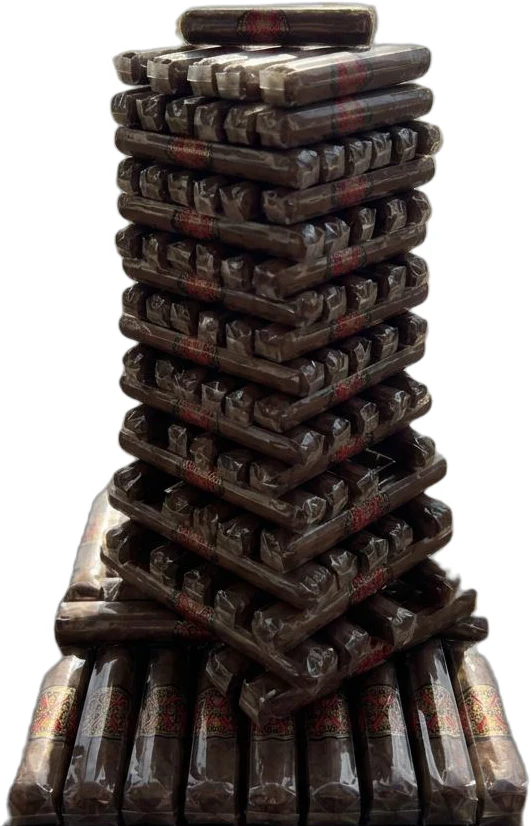
Five signs of tobacco quality
5 min read
A great cigar reveals its origin not through volume, but through details. The five signs of tobacco quality begin long before the first puff: in the leaf, the aroma, the tension of the roll, and that quiet balance that only time can produce. Those who recognize them no longer see a cigar as a mere product, but as the result of soil, harvest, maturation, and craftsmanship.
For connoisseurs, quality isn't a matter of a single characteristic. A flawless wrapper can mask a young, unbalanced tobacco. Conversely, a vibrant color says little about the depth of the blend. Only the interplay of these elements creates trust—and transforms a moment of smoking into a ritual of appreciation.
Five signs of tobacco quality in detail
1. Maturity is revealed in the scent
The assessment begins even before cutting the cigar. Hold it to your nose, first at the foot, then at the wrapper. High-quality, carefully aged tobacco has a clear and complex aroma: of cedarwood, earth, hay, leather, dried fruit, cocoa, or a subtle spice. The impression should be understated, but clean and precise.
A pungent, sour, or musty smell is not a good sign. It can indicate inadequate storage, excessive humidity, or incomplete fermentation. However, it's important to remember that not every cigar needs to have an intense aroma. Elegant formats, in particular, often reveal their depth only when smoked. The crucial factor is the natural subtlety of the aroma, not its intensity.
Maturation is one of the invisible qualities of a hand-rolled cigar. After fermentation, tobacco needs time for its edges to soften, for aromas to meld, and for the blend to develop its own unique character. This patience shapes the cigar's character far more than flashy packaging.
2. The cover is lively, not perfectly polished.
The wrapper leaf is the face of the cigar. It should be evenly taut, without any large tears, open seams, or dry spots. A fine, natural leaf structure and subtle veins are, however, inherent to tobacco. They are not necessarily a flaw, but rather an indication that a genuine natural product has been used.
Look for a smooth, harmonious color gradient. Minor variations are normal, especially in hand-selected leaves. Problematic are patchy discolorations, noticeable greenish areas, or a dull, papery appearance. These can indicate uneven ripening, premature processing, or unfavorable storage conditions.
Even the sheen tells a story. A good wrapper leaf doesn't look lacquered, but rather possesses a fine, natural shimmer. The essential oils of the leaf should be visible without the surface appearing greasy. This balance is subtle – and precisely for that reason a hallmark of discerning selection.
3. The roll requires tension combined with feeling
A premium cigar is hand-rolled, but craftsmanship doesn't mean mediocrity. Gently run two fingers over the body of the cigar. It should feel uniformly firm, without any hard knots or hollow areas. Slight variations are to be expected, especially with complex formats. However, noticeable irregularities increase the risk of a difficult draw or an uneven burn.
If rolled too tightly, the cigar remains closed and the draw becomes difficult. If rolled too loosely, it often burns hot and quickly, and the aromas lose their definition. The art lies between these extremes: in a construction that allows air to circulate but provides the tobacco with enough resistance so that it can slowly and coolly develop its nuances.
Weight can contribute to the overall impression. A cigar that appears substantial for its size often indicates careful filling. However, it's not a definitive judgment. Different tobacco varieties, ring gauges, and blends result in different weights. Quality isn't about quantity, but about controlled balance.
4. The cold draft reveals the signature of the mixture.
After a clean cut, the cold draw offers a first glimpse into the cigar's interior. It should be free, but not empty. A pleasant resistance is more reminiscent of drinking through a narrow straw than an open channel. This creates the conditions for a controlled, cool smoke.
The cold draw can already offer aromatic clues: wood, tea, pepper, sweet earth, dried fruit, or a creamy note. These impressions don't necessarily have to appear exactly the same in the final smoke. Rather, they indicate whether the leaves used have character and whether the blend has a recognizable direction.
A completely closed draw can indicate an overstuffed or unevenly rolled filler. Conversely, a noticeably open draw sometimes suggests that the filler was packed too loosely. Neither is always a definitive judgment on the entire cigar, but precision is to be expected from a boutique cigar.
5. Burning and ash confirm the first encounter
Only after lighting does it become clear whether the previous impressions hold true. A good cigar burns mostly evenly and produces a good, firm ash. A slightly uneven burn is not unusual with hand-rolled cigars – humidity, wind, lighting method, and the smoker's own drawing technique all play a role. A perfect burn is not a dogma.
More important is whether the cigar can be smoked smoothly with a few careful adjustments. Frequent go-outs, a consistently uneven burn, or unstable ash can indicate problems with the construction or moisture content. Again, consistency is key: a single cigar might be affected by transport or storage, but a recurring pattern is more informative.
The color of the ash is often overrated. A light, firm ash can be pleasing, but it doesn't, on its own, indicate high quality. It depends on minerals in the soil, leaf position, and processing. More telling are consistency, temperature, and aroma clarity. If the smoke remains cool and nuanced, this suggests a harmonious combination of tobacco and rolling technique.
Quality doesn't end at the cigar head.
Even the finest tobacco needs the right environment. A cigar stored too dry will be brittle, burn too quickly, and lose its aromatic depth. A cigar that is too humid will draw poorly, burn reluctantly, and may taste muted. Therefore, anyone judging a cigar should always consider its condition.
For storage, stability is more important than constant adjustments. A carefully maintained humidor not only protects the wrapper but also preserves the internal balance of the blend. After a trip or a change in climate, a cigar deserves a few days of rest. Especially in Switzerland, as well as in more tropical regions, the environment can significantly alter its behavior.
The difference between strength and depth
Strong tobacco isn't automatically better tobacco. A full-bodied cigar can impress with pepper, espresso, dark earth, and leather. A milder blend can be just as satisfying with creaminess, cedarwood, honey, and a subtle mineral freshness. Quality means that intensity and balance come together.
A successful blend develops over time. It may open up in the second third, intensify in the final third, or surprisingly reveal a new nuance. What it shouldn't do is become bitter, hot, or one-dimensional without transition. Complexity isn't about constant change. It can also lie in a clear, consistent line.
At Caminovacion Cigars, this attitude is part of their heritage: Dominican tobacco culture, interpreted through the lens of Swiss precision. Created for connoisseurs, not for a quick impression. Because the most compelling cigar doesn't need to explain itself – it reveals its quality puff by puff.
Enjoy with attention
The Five Signs are not a rigid testing protocol. They sharpen your perception, but they don't replace personal experience. Origin, format, ripeness, and personal preference all influence what is perceived as perfect. A slender Corona speaks differently than a generously sized Robusto , a sun-ripened wrapper differently than a darker, longer-fermented variety.
Therefore, take your time: examine the leaf, check the roll, smell the foot, and light the cigar without haste. The true measure is that moment when construction, aroma, and conversation form a harmonious whole. Then, tobacco quality becomes not just a mark of distinction, but the art of the moment.